Showing posts with label basics. Show all posts

Wednesday, May 14, 2008

Asparagus and Shrimp Risotto **


I am giving this recipe two stars, not so much for the asparagus and shrimp, but for the basic risotto recipe which can be adapted in a million ways.
This is Jamie's risotto, a recipe we tried years ago when we made our first risotto, and we are using the same one ever since. That's how good it is.
There is a lot of Parmesan cheese in the basic recipe, which you better leave out if you are using shrimps, but otherwise the process is the same.


Serves 2-3 as a main dish
- about 1/2 litre vegetable or chicken stock (equiv. 2 small cubes)
- 4 tablespoons olive oil
- 1 small onion, finely chopped
- 1 large stick of celery, grated
- 250gr Arborio or Japonica rice
- 50ml vermouth (or Marsala, Martini bianco)
- 50ml white wine
- one bunch of asparagus, woody ends removed
- 150gr shrimps (frozen is fine too)
- 2 tablespoons lemon juice
- dried basil (or fresh one)
- salt, pepper
- about 30gr butter
- grated Parmesan cheese "à volonté"


Peel the asparagus and chop them into stalks of about 3cm, keeping the tips whole.
Boil them in salted water for about 10 minutes, and reserve.

Start making your basic risotto recipe.
Bring the stock to a simmer in a saucepan. Put the olive oil in a separate large pan, add the onion and celery and cook very gently for about 5 minutes, without colouring, until soft. Add the rice (it will sizzle) and turn up the heat. Don't let the rice or veg catch on the bottom of the pan, so keep it moving.

Pour in the vermouth and wine. Keep stirring all the time until it has evaporated, leaving the rice with a lovely perfume.

Add the stock to the rice a ladle at a time, stirring and waiting until it has been fully absorbed before adding the next. Turn the heat down to low so the rice doesn't cook too quickly, otherwise the outside of each grain will be stodgy and the inside hard and nutty (you don't want to cook it too slowly either, or it will turn into rice pudding!) and continue to add ladlefuls of stock until it has all be absorbed. It should take about 30 minutes for the rice to have softened but is still a little al dente. Check the texture from time to time. You might not need to add all the stock.

You can now add the shrimps and lemon, and when the shrimps are cooked (5min), gently stir in the asparagus (without the tips). Adjust the taste with salt and pepper.

Turn off the heat, beat in your butter (and a handful of Parmesan if you are using it) and basil. Check the seasoning. Put a lid on the pan and leave the risotto to rest for a minute.

Serve with a drizzle of olive oil and decorate with the tips of the asparagus. If you are not cooking a shrimp risotto, sprinkle generously with freshly grated Parmesan.


-----


Voici le fameux risotto de Jamie, celui que nous faisons depuis plusieurs années. En fait nous n'avons pas changé de recette depuis le premier essai risotto. Les variantes sont bien sûr infinies. Nous faisons souvent la version "champignons-jambon de Parme", ou "Bleu-crevettes", ou même "potiron-sauge" par exemple.
La recette de base contient beaucoup de Parmesan, mais si vous faites un risotto aux crevettes ou au poisson il est recommendé de ne pas en ajouter.


Pour 2-3 personnes
- environ 1/2 litre de bouillon de légumes ou de volaille
- 4 c.soupe d'huile d'olive
- 1 petit onion, finement haché
- 1 grosse branche de céleri, rapée
- 250gr de riz Arborio ou Japonica
- 50ml de vermouth (ou bien Martini blanc, Marsala...)
- 50ml de vin blanc
- une botte d'asperges vertes
- 150gr de crevettes (même congelées)
- 2 c.soupe de jus de citron
- basilic (séché ou frais)
- sel et poivre
- environ 30gr de beurre
- du Parmesan à volonté


Peler les asperges et les couper en petits tronçons d'environ 3cm, en laissant les pointes entières. Les faire cuire 10 minutes dans de l'eau salée, et réserver.

Faire chauffer le bouillon dans une petite casserole.
Verser l'huile d'olive dans une autre grande casserole ou cocotte, ajouter l'oignon et le céleri, et faire cuire à feu doux pendant environ 5 minutes, en remuant et sans laisser brunir. Ajouter le riz sur feu modéré/vif et continuer à mélanger jusqu'à ce que les grains deviennent translucides (quelques minutes).
Mouiller avec le vermouth et le vin blanc, tout en remuant jusqu'à ce que tout soit évaporé.

Ajouter le bouillon louche apres louche, en remuant et en laissant le riz absorber le liquide entre chaque louche. Controler la cuisson de temps en temps. Peut-être que vous n'aurez pas besoin d'utiliser tout le bouillon. Apres 30 minutes, le riz devrait être presque cuit, juste légèrement al dente.

Vous pouvez alors ajouter les crevettes et le jus de citron, et après 5 minutes, les asperges (sans les pointes). Ajuster avec sel et poivre.
Retirer du feu, ajouter le beurre et le basilic (et une poignée de Parmesan si vous en utilisez). Couvrir et laisser reposer une minute.

Servir avec un filet d'huile d'olive et décorer avec les pointes d'asperges.
Pour un risotto sans crevettes ou poisson, parsemer généreusement de Parmesan.

Friday, March 28, 2008

Our Fresh Pasta Recipe **, Gorgonzola and Spinach Sauce

We recently got a pasta machine, and even more recently bought fancy pasta plates. This means that we are quite often in the mood for pasta.
We wanted to try a sauce that is different from our all time favorite meat sauce, and this one was fantastic! (I should stop being so modest...)


Serves 2

For the pasta
- 90gr gluten flour
- 60gr soft flour
- 50gr durum semolina flour
- 2 eggs
- a pinch of salt


** edit: pasta dough for lasagna sheets:
- 4 eggs
- 150g soft flour
- 130g strong flour
- 120g semolina
- 1/2 teaspoon salt
rest at room temp for 1hour
make this dough with 3 egg to avoid leftover
roll out thin

*** edit 2026.01.04  good pasta dough for ravioles, lasagna....
- 200 g 00 flour (e.g. Caputo pizza flour)
- 100 g semolina
- 3 eggs
- pinch of salt
Roll out VERY thin. 
Can cut out large squares for ravioles, very good.


For the sauce
- 150ml heavy cream
- about 60gr Gorgonzola cheese (or Blue cheese)
- 2 cloves garlic
- salt, pepper
- 1/4 teaspoon grated nutmeg
- white wine
- about 150gr fresh spinach
- 6 Shitake mushrooms (or other), chopped
- Parmesan cheese


In a bowl, mix the flours and salt, make a well. Crack the eggs in the middle and mix everything with one hand.
When the dough doesn't stick to the hand anymore, transfer to a flat surface, and knead for 15 minutes (if the dough is a little bit sticky, add a bit of semolina. It depends on the size of the eggs).
Form a regular ball without wrinkles, wrap it with cling film and let it rest in the fridge for 2 hours.
If you do not have a pasta machine, roll out the dough as thin and as regular as possible. This is quite tricky and never worked for us, I am afraid.
If you are using a machine, take half of the dough at a time. Roll it out a little to give an approximate oval or rectangular shape. Pass it through the pasta machine (divide again if it becomes too long) from the setting nr.7 up to nr.3 (only once per setting). We don't go until setting nr.1 as we like a bit of crunch. Pass the sheets through the tagliatelle knife. Leave the pasta on a hanger (it is OK if the pasta dries for 15 minutes, no worries) while you make the sauce.
Fresh pasta needs very little cooking time. Put a large amount of water to the boil, add salt, a little bit of olive oil, and boil the tagliatelle for 3 minutes. Serve immediately.


For the sauce:
Roughly chop the spinach and boil them in salted water for a couple of minutes. Rinse under cold water and very slightly squeeze out excess liquid. Reserve.
Heat up a bit of olive oil in a frying pan and brown the mushrooms. Add a few tablespoons white wine, then the cream, salt, papper, crushed garlic, nutmeg, Gorgonzola cheese, and spinach in the end.
Sprinkle with Parmesan cheese after topping the pasta.


-----


Pour les pâtes fraîches, 2 personnes:
- 90gr de farine de gluten
- 60gr de farine pour boulangerie (T55)
- 50gr de durum semolina
- 2 oeufs
- une pincée de sel


Pour la sauce:
- 150ml de crème fluide pour chantilly
- environ 60gr de Gorgonzola (ou du Bleu)
- 2 gousses d'ail
- sel, poivre
- 1/4 c.café de noix de muscade moulue
- vin blanc
- environ 150gr d'épinards frais
- 6 champignons Shitake (ou autres champignons bruns), en tranches
- Parmesan


Dans un saladier, mélanger les farines et le sel, et faire un puits. Ajouter les oeufs et mélanger le tout avec une main.
Quand la pâte ne colle plus aux doigts, la transférer sur une surface plane et pétrir pendant 15 minutes. Si elle colle encore légèrement après 5 minutes, rajouter un peu de semolina.
Former une boule régulière, l'envelopper de film alimentaire et laisser reposer au frigo pendant 2 heures.
Si vous n'avez pas de machine à pâtes, étaler la pâte aussi finement et régulièrement que possible, et découper des tagliatelles (assez difficile!).
Avec la machine à pâtes, travailler avec une moitié de la pâte à la fois. L'étaler sur environ 1 cm en lui donnant une forme ovale ou rectangulaire, et la passer dans la machine, de la position la plus haute jusqu'à la 3 (la position 1 étant la plus fine). Ne la passer qu'une seule fois pour chaque position.
Couper les tagliatelles, et les laisser sécher sans qu'elles se collent pendant que vous préparez la sauce.
Pour la cuisson, les faire bouillir dans de l'eau salée (on peu aussi ajouter un peu d'huile d'olive) pendant 3 minutes, et servir immédiatement.


Pour la sauce:
Faire bouillir les épinards coupés pendant 2 minutes dans de l'eau salée. Les rincer à l'eau froide, légèrement presser pour enlever l'excès d'eau, et résever.
Faire chauffer un peu d'huile d'olive dans une poelle et faire brunir les champignons. Déglacer avec du vin blanc et ajouter la crème, l'ail écrasé, sel, poivre, noix de muscade, Gorgonzola, et les épinards avant de servir.
Verser sul les pâtes et garnir de Parmesan fraîchement rapé.

Saturday, February 10, 2007

Meat sauce (Ragout) **

We love italian food. I don't know if it was them who originally came up with the divine combination of tomato, garlic, basil and cheese, but that is just sheer genius. Yes, alright, they have a variety of dishes in different parts of Italy, but let's face it. That is Italian food. It is like the French are known to put garlic in every dish, the Japanese are supposed to pour soy sauce on everything .

Anyway, this is our somewhat basic sauce using tomato, garlic, meat and basil. It is close to what the Italians would call a Ragout (pronouced ra-guu, not rag-out) but we call it the "meat sauce" because it is usually called mee-toh soh-su in Japan.


- 2 table spoon of olive oil
- 2 cloves of garlic (3 if you are an Italian, 4+ if you are from France)
- 1 onion, finely chopped
- 1 big carrot, grated
- 1 celery branch (or 1/4 celeriac), grated
- 3-4 strips of bacon, chopped
- about 600gr minced meat (beef or a mix beef/pork)
- 2 glasses of red or white wine
- 2 tins of peeled tomatoes (250gr each)
- about 150ml tomato puree
- 1 or 2 cubes of beef stock
- salt, pepper, dried oregano and basil
- 1 bay leaf
- 1 clove
- 1 teaspoon sugar
- freshly grated Nutmeg
- freshly grated Parmesan
- fresh basil (optional)

Put the olive oil and squashed garlic into the deep cooking pan and start heating it with moderate heat. Put bacon and onion when the garlic starts to sizzle. lower the heat and mix till the onion bits become translucent. Then put the grated carrot and cerely into the pan. Turn up the heat a bit and mix, add the minced meat, salt and pepper and turn up the heat a bit more to cook the meat.

When the meat is half cooked, add the tomatoes and the juice from the tin with some tomato puree. Rinse the tin with two glasses of wine and put them in the pan as well. Keep stiring it and add the beef stock cubes, clove, sugar, nutmeg and bay leaf. Put the lid on (with a small gap for the pressure to escape) and simmer it for about 1-2 hours on low heat.

Check it every 20min and stir to make sure it does not get burned at the bottom of the pan. If it is too liquidy for your taste, take away the lid and simmer it for a while till you are happy with it.

This sauce could be used for spaghetti Bolognese (add parmesan and basil and stir before serving) or preparing Lasagna. I pesonally feel that the sauce tastes better after a day or two in the fridge.

A bit of footnote: Get a good tin of tomatoes. In our local supermarkets, the price range is something like 60 yen to 110 yen. For this sauce I would go for the 110 yen tins that are less watery than the cheaper brands.

Monday, November 13, 2006

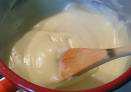
Sauce Bechamel **

Bechamel, or white sauce, is a base for many dishes. For us it is important to have a good recipe for it, because we use it when we cook lasagna, and we love lasagna.
There are several schools when it comes to making Bechamel. I guess this recipe is from the "Add milk when it's warm, and little by little"-school.
You need:
- 50gr unsalted butter
- 50gr flour
- 500ml milk
- salt, pepper, nutmeg

In a saucepan, slowly heat up the milk until just below boiling point.
Meanwhile, melt butter over low heat in another saucepan. When it starts to foam, add the flour, mixing well with a wooden spoon. Cook over low heat 3 to 4 minutes, stirring constantly.
Add the scalded milk a little at a time, and stir well to incorporate everything before adding the next amount. If the milk is warm the butter won't split, and there won't be any lumps.
When all the milk is added, season with salt, pepper and grated nutmeg.
Voila.