Showing posts with label Thai and Indian. Show all posts

Wednesday, July 22, 2009

Sate Ayam (Spicy Chicken Skewers with Sate Sauce)


serves 3:

600gr chicken breasts or boneless thighs

marinade:
1 lemon grass, bashed up
2 cloves garlic, crushed
1 teasp turmeric
1/2 teasp chili powder
1 teasp red curry paste
2 tablesp (level) sugar
1/2 teasp salt
1 tablesp peanut oil
1 tablesp dried coriander

sate sauce:
1 lemon grass, bashed up
1 teasp tamarind, diluted in warm water
2 dried chili peppers, chopped
1 clove garlic, crushed
1 teasp grated ginger
1 tablesp honey
1 teasp ground coriander
1 tablesp fresh coriander, chopped
1 cup peanuts or cashew nuts, finely crushed
1 teasp tahini (sesame paste)
pinch of salt
a few curry leaves
1 teasp lemon juice
water to the apropriate thickness of the sauce

wooden skewers


Cut the chicken into small bits that will easily cook on a skewer. Mix them with all the ingredients of the marinade and let them rest in the fridge for at least 2 hours.

Mix all ingredients of the sauce in a saucepan and heat them up to boiling point. Remove from the heat.

Soak the wooden skewers in water for at least 20min (avoids burning), and thread the marinated chicken onto them.
Grill or barbecue them until golden, serve with the sate sauce, vegetables and basmati rice.

Friday, July 17, 2009

Thai Chicken Mango Curry *


Serves 3-4

- 2 small thai mango or a big one
- 1 can coconut milk
- 1/2 teasp powdered stock in 100ml water
- 4 teasp red curry paste
- 2 teasp fish sauce
- 1 tablesp mango chutney
- 2 teasp freshly grated ginger
- 1 teasp turmeric
- 2 cloves crushed garlic
- a pinch of salt
- 1 tablespoon lemon juice
- 1/2 tablesp honey
- 1 red bell pepper, cut in pieces (2cm)
- 600gr chicken breasts, cut in small pieces (2-3cm)


Cut 1/3rd of the mango in small cubes and reserve for topping.
Blitz the other 2/3rds of the mango to a pulp, add it to a pan with all other ingredients except chicken, mix and bring to a simmer over low heat. Let it sizzle gently for 20-30min to let the flavours develop.
Add the chicken and continue cooking for about 15min.
Serve with basmati rice and decorate with the reserved mango cubes.

Edit: works also very well with pineapple as a substitute for mango!

Wednesday, May 20, 2009

Lamb Biryani with Aubergine Raita

This dish is a little bit elaborate but totally worth the fuss. At least for us spice addicts, flavour and taste are just perfect!


Serves 4:

1kg lamb shoulder, without bone and fat, cubbed
vegetable oil
2 onions, thinly sliced
9 whole green cardamon pods
1/2 teaspoon ground black peppercorns
1 teasp coriander seeds
1 teasp ground coriander
1/4 teas ground clove
1 teasp ground cumin
1/2 teasp chilli powder
1 teasp grated ginger
2 teasp salt
3 garlic cloves, mashed
juice of 1 lemon (about 40ml)
water
200ml yoghurt
1 teasp garam masala
2 tablsp fresh chopped coriander
275g basmati or jasmin rice
2-3 whole cloves
5cm piece cinnamon stick
1 teasp turmeric (or saffron if possible)
50ml milk
2 bay leaves
a handfull of sliced almonds

Aubergine Raita:
3 small aubergines (japanese size)
300ml yoghurt
a pinch of salt
a pinch of ground cumin
dried coriander to decorate


In a wok or a frying pan, brown the meat on every side in a little bit of oil, and set aside.
In a wok, deep fry the onions, in 3-4 batches on low/medium heat. It will take about 10min per batch, they should have a nice golden colour without getting dark brown. Set them aside on a plate overlaid with absorbing kitchen paper.
Grind 5 cardamon pods, the peppercorns and coriander seeds with pestle and mortar. Combine with ground coriander, ground clove, ground cumin, chilli powder, ginger.
In a large pan, heat up a few tablespoons of oil. Add the spice mix on low heat and fry for a couple of minutes. Add half of the fried onions and continue stirring for a minute. Add the lamb meat, garlic and salt and mix well, let it get coated with all the spices for a few minutes. Add the lemon juice, and water to cover up the meat. Let it go back to sizzling and remove the impurities that come up to the surface. Cook for a further 5 minutes and remove from the heat.
Incorporate the yoghurt, 1 tablespoon a time, mixing well inbetween each tablespoon. Put back on low heat and let the curry simmer for two hours, until the lamb is very tender.
Add the fresh coriander and garam masala, mix well, cover and let it rest for 30min at room temperature to develop the flavour.
Preheat the oven to 180 degreesC.
Meanwhile, wash the rice in cold water and soak it for 30min. Boil a large amount of water, add 2 teaspoons of salt, 4 whole cardamon pods, 2-3 whole cloves, the cinnamon stick, and boil the rice for 5 minutes. Drain the water, and keep the rice warm (with the whole spices) and covered.
Dilute the turmeric in milk and set aside.
Set up the Biryani. My alsacian claypot terrine work well for that, otherwise a large pot with tight lid will also do. Start with a layer of meat (half of the lamb) with 2-3 tablespoons of the curry sauce. Overlay with half of the remaining fried onions, and half of the rice. Drizzle half of the turmeric-milk over the rice.
Continue layering with the other half of the meat, fried onions, rice, turmeric milk.
Pour 100ml of the curry sauce, top with two bay leaves, cover, and bake for 30min at 180 degreesC.
Meanwhile, roast the almonds in a dry frying pan for a few minutes until they get some colour, and set aside.
Serve the Biryani strait from the clay pot, with an aubergine raita and topping of almonds.


Aubergine Raita:
Wash and cut the small aubergines in half (longitudinal) and put then under a grill until the flesh softens and can be scooped with a spoon. Collect the flesh and homogenize it in a blender. Let it cool down and add yoghurt, a pinch of salt and ground cumin and put in the fridge until serving. Decorate with dried coriander.

Monday, May 04, 2009

Salmon and Cabbage Tamarind Curry


Serves 3-4

3 tbsp tamarind juice (taken form 1 tbsp block in 100ml warm water)
6 salmon filets
1 teasp salt
1 small onion
2 tbsp vegetable oil
2 cloves garlic
1 teasp grated ginger
1 teasp ground coriander
1 teasp ground cumin
2 teasp ground turmeric
2 dried chillies
1 tbsp tomato purée
400ml coconut milk
about 200ml water
1/2 teasp garam masala
1 teasp brown sugar
1/4 cabbage, leaves roughly chopped
2 tbsp fresh coriander leaves, chopped


Prepare the tamarind by softening 1 tbsp tamarind block with 100ml warm water.
Cut the salmon into bite-sized chunks, rub with 1/2 teaspoon of the salt and set aside.
Halve and finely slice the onion. Heat the oil in a heavy-based pan and fry the onion until soft, but not coloured. Add the crushed garlic and ginger and fry for a further 1 minute, stirring all the time.
Turn the heat down low, sprinkle over the ground coriander, cumin, turmeric, and chillies, and stir continuously until the spices give off a warm, toasted aroma - about a minute.
Add 3 tbsp of the tamarind juice, tomato puree, coconut milk, water, the remaining salt, garam masala, and the sugar. Simmer the curry, uncovered, for about 15 minutes before tasting. If you feel the curry needs it, add a touch more tamarind and chilli.
Add the cabbage and cook for another 10 minutes. Add the fresh coriander and the fish to the pan and simmer for 5 minutes, or until cooked. Serve with steamed rice.

Tuesday, March 31, 2009

Chicken in a Cashew Nut Sauce


Serves 4-5

2 onions
1 tablesp tomato purée
40g cashew nuts
2 teasp garam masala
2 cloves garlic
1/2 teasp chilli powder
1 tablesp lemon juice
1 teasp turmeric
2 teasp salt
1/2 teasp cumin powder
2 tablesp yoghurt
vegetable oil
1 tablesp fresh coriander, plus extra to garnish
1 generous tablesp sultanas (golden raisins)
750g chicken breast fillets, skinned and cubed
about 300ml water
6-8 mushrooms


Cut the onions and garlic into thick slices, then place in a food processor or blender. Process for 1 minute.
Add the tomato purée, cashew nuts, garam masala, chilli powder, lemon juice, turmeric, salt, cumin powder and yoghurt and process for a further 1 min until homogenous.
In a large pan, heat about 3 tablespoons oil, lower the heat to medium and pour in the onion and spice mixture. Fry gently, stirring frequently, for about 2 minutes, lowering the heat if necessary.
Add the fresh coriander, sultanas and cubed chicken to the pan and continue to stir-fry for a further minute.
Add the mushrooms, pour in the water and bring to a simmer. Cover the pan and cook over a low heat for about 10 minutes.
After this time, remove the lid and cook a little bit more until the sauce thickens and the chicken is tender. For another 10-15 minutes if necessary.
Transfer to a serving dish and garnish with fresh chopped coriander. Serve with plain boiled basmati rice.

Friday, August 22, 2008

Khao Kup Gapi **

This dish is H's adaptation of a popular Thai dish which rapidly became my favorite "weekend-lunch-summer-dish". Gapi rice contains a lot of Gapi (shrimp paste), smelly but sooooo addictive!


Serves 2

- 300gr minced meat (a mix of beef and pork)
- sesame oil
- 1 teaspoon grated ginger
- 1 teaspoon chinese broth powder
- 2 tablespoons white wine
- 1/2 tablespoon oyster sauce
- 1 garlic clove, mashed
- a pinch of sugar
- a few leaves of fresh coriander (optional)

- sesame oil
- 2 bowls of cooked rice
- 2 teaspoons gapi
- pepper
- finely chopped spring onion

- 2 eggs
- sliced cucumber or tomatoes
- lemon juice and fish sauce à volonté


Chop the vegetables in thin slices and reserve.

Prepare the meat: in a wok, sauté the minced meat in a little bit (not too much) of sesame oil. Add ginger, broth powder, wine, oyster sauce, clove, sugar, coriander, and stir until cooked (about 5 minutes). Set aside.

Prepare the gapi rice: in the same wok, heat up sesame oil and add the gapi. Stir well until the color changes to a deep red (30seconds), then add the cooked rice little by little, as you would do for fried rice, mixing well with a spatula.
Add some pepper and the spring onion. Set aside.

Fry your eggs sunny side up in a frying pan.

Divide the rice between two bowls. Top with the minced meat, the vegetables and the egg, and serve.
Add fish sauce and lemon juice and mix everything. Bon ap'!

Friday, July 11, 2008

Thai Meat Ball Curry **


I have inserted a small picture of the dish because photography was not exactly successful! The curry was very good though and we'll do it again, so there will be other opportunities.
We wanted to test our newly acquired shrimp paste (kapi), and it does make a difference.


Serves 3

For the meat balls
- 500gr minced meat (mix of beef/pork)
- 1 small clove garlic, mashed
- 1 egg
- 1 tablespoon sake or chinese liquor
- 1 large tablespoon bead crumbs
- 1/2 teaspoon fennel seeds, crushed to powder
- 1 teaspoon cumin powder
- 1/2 tablespoon fish sauce
- 1/2 teaspoon cayenne pepper
- salt, pepper from the mill
- flour for coating the meat balls

For the sauce
- 1 can of coconut milk or coconut cream
- 1 clove garlic, mashed
- 150ml chicken stock
- 3 teaspoons red curry paste
- 1 teaspoon turmeric
- 1/2 teaspoon cumin powder
- 1 teaspoon shrimp paste
- 3-4 teaspoons fish sauce
- 1 teaspoon soy sauce
- 3 tablespoons lemon or lime juice
- 1 tablespoon light brown sugar
- a bunch of fresh spinach, roughly chopped
- fresh coriander leaves


Prepare the meat balls: combine all ingredients for the meat balls in a large bowl. Mix thoroughly (better with your hands).
Form balls of about 3cm diameter and slightly coat them with a bit of flour to avoid sticking. Reserve in the fridge.

Prepare the sauce: Pour the coconut milk in a large sauce pan. Add the shrimp paste and curry paste and beat with a whisk until they have dissolved. Add the stock, mashed garlic, cumin, turmeric, fish sauce, soy sauce, brown sugar, lemon juice, and mix. Now turn on the gas and let the sauce cook over low heat for about 10 minutes to bring all the flavors together.
Add the meat balls one by one, and continue cooking for at least 15 minutes (longer is fine).
Finally, add the spinach and coriander leaves, cook for a few more minutes and serve with rice.

Monday, June 23, 2008

Tandoori Chicken

Tandoori Chicken is a popular Punjabi dish, where chicken is marinated in yoghurt and spices, and traditionally cooked at high temperatures in an earthen oven (tandoor). If you don't own a tandoor it can also be grilled or cooked in the oven as we did.
As cooking chicken in the oven slightly dries up the meat, we served it with a spicy tomato sauce.


Serves 4

-750gr boneless chicken thighs, in chunks of about 3-4cm

For the marinade:
- 2 cups plain yoghurt (400ml)
- 2 teaspoons cumin powder
- 4 cardamon pods, powdered
- 1/2 teaspoon cayenne pepper
- 2 teaspoons grated ginger
- 2 cloves garlic, mashed
- 3 tablespoons paprika powder
- 1 tablespoon lemon juice
- 1 teaspoon salt


For the sauce:
- 1 onion, finely sliced
- vegetable oil
- 2 cloves
- 2 bay leaves
- 2 garlic cloves, mashed
- 1/2 teaspoon cinnamon
- 1/2 teaspoon fenugreek
- 1 teaspoon turmeric
- 1 teaspoon grated ginger
- 1 teaspoon cumin powder
- 2 tomato cans
- a pinch of sugar
- a pinch of salt and pepper
- water (about 100ml)
- 30gr butter
- 50ml milk


Combine all the ingredients of the marinade, add the chicken and mix, cover and let it rest in the fridge for at least 6 hours, or overnight.

For the sauce, sauté the onion in a wok pan with a little oil, cloves and bay leaves. Add garlic, cinnamon, fenugreek, turmeric, ginger, cumin, and continue stirring.
Add the tomato cans, sugar, salt, pepper, and water. Let it simmer for one hour over low heat.

Pre-heat the oven to 210 degrees C.
Place the marinated chicken in an oven-proof dish (without too much overlapping) and cook at this temperature for about 25 minutes, depending on your oven.

Towards the end of the cooking time, add butter and milk to the sauce and adjust the taste.
Serve Tandoori chicken with the sauce and white rice.


-----


Le poulet Tandoori est un plat Indien très populaire, très parfumé grâce aux nombreuses épices de la marinade.
Comme la cuisson au four dessèche légèrement le poulet, nous le servons avec une sauce à base de tomates et d'épices. Et ça y est, on est en Inde..


Pour 4 personnes

- 750gr de hauts de cuisses de poulet, sans os, en morceaux de 3-4cm

Pour la marinade:
- 2 cups de yahourt (400ml)
- 2 c.café de cumin en poudre
- 4 graines de cardamone, en poudre
- 1/2 c.café de piment de cayenne
- 2 c.café de gingembre râpé
- 2 gousses d'ail, écrasées
- 3 c.soupe de paprika
- 1 c.soupe de jus de citron
- 1 c.café de sel


Pour la sauce:
- 1 oignon, finement ciselé
- huile végétale
- 2 clous de girofle
- 2 feuilles de laurier
- 2 gousses d'ail, écrasées
- 1/2 c.café de cannelle
- 1/2 c.café de fenugrec
- 1 c.café de curcuma
- 1 c.café de gingembre râpé
- 1 c.café de cumin en poudre
- 2 boites de conserves de tomates
- une pincée de sucre
- une pincée de sel et de poivre
- environ 100ml d'eau
- 30gr de beurre
- 50ml de lait


Dans un saladier, mélanger tous les ingrédients de la marinade et le poulet. Couvrir et laisser reposer au frigo pendant au moins six heures ou toute une nuit.

Préparer la sauce: Dans un wok, faire revenir les oignons dans un fillet d'huile avec les clous de girofle et les feuilles de laurier.
Ajouter l'ail, la cannelle, le fenugrec, le curcuma, le gingembre, le cumin, et continuer à remuer.
Ajouter ensuite les tomates, une pincée de sel, poivre et sucre, et l'eau. Laisser mijoter sur feu très doux pendant une heure.

Préchauffer le four à 210 degrés. Disposer le poulet dans un plat creux allant au four (en Pyrex par exemple), et le faire cuire pendant environ 25 minutes selon le four.

Vers la fin de la cuisson, ajouter le beurre et le lait à la sauce.
Servir le poulet Tandoori à la sortie du four avec la sauce et du riz.

Saturday, March 08, 2008

Saag Gosht (Lamb in Spinach Curry)

We had this curry at the restaurant a couple of times and I really loved it, so we gave it a try at home, and it was a success.
The only problem with this curry is that it is not photogenic, to say the least... I challenge anyone to take an apetizing photo of Saag Gosht. So once again, don't get turned off by the picture, just try it!


Serves 4

- 800gr boneless leg or shoulder of lamb, cut into appr. 2.5cm cubes
- 2 onions, finely sliced
- 3-4 tablespoons ghee (clarified butter)
- 2 teaspoons cumin powder
- 2 teaspoons turmeric
- 1 teaspoon chili powder
- 2 teaspoons ginger paste (or freshly grated ginger)
- 2 teaspoons coriander seeds, crushed to powder
- 4 cardamon pods, crushed to powder
- 10 black peppercorns, crushed
- 3 cloves
- 2 bay leaves
- a pinch of nutmeg
- 3 garlic cloves, mashed
- salt (at least 1 teaspoon)
- 1 can of diced tomatoes (400ml)
- about 100ml water
- 300gr yoghurt
- 2 teaspoons dried chili flakes (optional)
- 400gr fresh spinach


In a frying pan, brown the lamb with a little oil, and set aside.

Heat up a wok pan and then the ghee. Lower the heat and add the sliced onions. Keep frying for about 20 min over low heat until they are soft and golden.
Add the cumin, turmeric, chili powder, ginger, coriander, cardamon, peppercorns, cloves, nutmeg, bay leaves, and fry for a couple of minutes. It will smell fantastic.
Add the tomato can, water, garlic, salt, and cook for a couple of minutes. Remove the cloves and the bay leaves and set them aside.
Stir in the yoghurt, mix and remove from the heat.
When it is somewhat cooled down, purée everything in a blender or a food processor.
Put the mixture in a large pot together with the lamb. Add the chili flakes, 2 of the reserved cloves and one bay leaf, and let it sizzle over low heat for 2 hours (lid on with a small opening).
Boil the spinach for 2-3 minutes and purée with a blender or a food processor.
Fifteen minutes before the end of the cooking time, add the spinach to the lamb curry and mix.
You can do this curry in advance, let it rest for a while and heat it up again just before eating.
Serve with Naan bread or rice.

Sunday, March 02, 2008

Fluffy Naan Bread


Since we cook a lot of Indian curry these days we sometimes want to have Naan bread with it.
This bread is not difficult and doesn't need a lot of kneading at all, which is always a good thing.


for 4 small Naans (2 persons)

- 100gr all purpose flour
- 100gr high gluten flour
- 50gr plain yoghurt
- 2 tablespoons ghee (clarified butter. Alternatively: unsalted butter, melted)
- 80ml tepid water
- 1 teaspoon dry yeast
- 1 teaspoon salt
- 1 teaspoon sugar


Activate the yeast in tepid water for 5-10 minutes until it gets bubbly.
In a bowl, mix the flours, salt, sugar, and make a well. Add the yoghurt and ghee and start mixing with one hand. Add the yeast in water little by little.
Mix everything until you obtain a homogeneous dough and work it with your hand for just a few minutes to incorporate some air. It will be a rather wet and soft batter.
Cover and let it rise in a draft-free place (inside your oven is fine) until it has at least doubled in volume (it can take 3-4 hours).
When it is ready, divide it in 4 equal portions, and form a little ball with each of them. Let them rest again for about 30 minutes in your oven. We put a cup of boiled water beside them during this step to keep the dough moist.
When you are ready to eat, roll out the balls to about 1/2cm and give them an elongated shape.
Heat up a frying pan without any oil or butter. Add 2 Naans at a time and cook over medium heat for a bout 2 minutes on each side. Cover with a lid during that time. Cooking the Naans in a frying pan works much better than in the oven for us.
Enjoy with your favourite curry!


----


Pour 4 petits Naans (2 personnes)

- 100gr de farine pour pâtisserie
- 100gr de farine de gluten
- 50gr de yahourt nature
- 2 c.soupe de ghee (beurre clarifié. A defaut, du beurre non salé, fondu)
- 80ml d'eau tiède
- 1 c.café de levure sèche
- 1 c.café de sel
- 1 c.café de sucre


Activer la levure en la diluant dans l'eau tiède, et laisser pendant 5-10min jusqu'à ce que le mélange fasse des bulles.
Dans un saladier, mélanger les farines, le sucre et le sel, et faire un puits.
Y ajouter le yahourt et le ghee et commencer à mélanger avec une main. Ajouter petit à petit la levure diluée et mélanger jusqu'à obtention d'une pâte homogène.
Travailler la pâte pendant quelques minutes seulement en la soulevant pour incorporer de l'air. Elle ne se détachera pas entièrement des doigts, mais tout va bien.
Couvrir le saladier et mettre à lever dans un endroit sans courants d'air (par exemple dans le four) jusqu'à ce que la pâte ait au moins doublé de volume. Cela peut prendre 3-4 heures.
Au bout de ce temps, diviser en 4 parts égales et former de petites boules.
Les remettre au repos dans le four pendant environ 30 minutes (nous ajoutons un bol d'eau bouillie dans le four pour garder un taux d'humidité élevé).
A l'aide d'un rouleau a pâtisserie, abaisser les boules sur environ 1/2 cm en donnant une forme allongée aux Naans.
Chauffer une poelle sans graisse et faire cuire les Naans à sec, deux à la fois, pendant environ 2 minutes de chaque côté. Couvrir avec un couvercle pendant la cuisson.

Monday, February 18, 2008

Prawn and Cabbage Curry

The Paw and I are sort of curry addicts. We like all kinds of curries and we could cook and eat curry any time. Indian curry is probably my favourite, especially if it comes with Naan bread (recipe will feature soon).
I was first sceptical about the association of tomato and coconut cream, but if you ever try you will surely come back to it as it does work really well.


Serves 2-3


- 2 tablespoons ghee (clarified butter, see below)
- 1 small onion, finely sliced
- 1 teaspoon coriander seeds, crushed to powder
- 1 teaspoon cumin powder
- 1 teaspoon paprika
- 1 teaspoon chili powder
- 2 teaspoons turmeric
- 2 teaspoons ginger paste (or freshly grated ginger)
- 2 cloves of garlic, mashed
- 1 can diced tomato (400ml)
- a pinch of sugar (1/2 teaspoon)
- a good pinch of salt
- about 300ml coconut cream (or coconut milk)
- 16 prawns
- about 1/3 of a small round cabbage, leaves trimmed and chopped relatively large.
- 2 teaspoons dried chili flakes (optional)
- a small bunch of fresh coriander


Ghee is clarified butter, important in Indian cuisine and also used in Egyptian and Ethiopian/Eritrean cuisines. It is considered a "healthy" fat, but more importantly it gives a characterictic flavour to your dish. You can prepare your own ghee (I did) by simmering unsalted butter in a large pot until water has boiled off and milk has curdled. For a recipe see here

If you are using raw prawns, which is recommended, peel away the shell and leave only the very end of the tail. Remove the intestinal vein that runs down the back with a toothpick. Reserve in the fridge while you start cooking.

In a wok pan, heat up the ghee, and brown the sliced onion over medium/low heat for about 10 minutes.
Add coriander seeds, cumin, paprika, chili, turmeric, ginger, and fry for a couple of minutes.
Add the tomato can and mashed garlic, salt, sugar, and cook for 5 minutes.
Stir in the coconut cream and let the flavours come together for about 15 minutes over medium heat, uncovered.
Add the cabbage and the prawns, chili flakes, and simmer for 10 more minutes.
Sprinkle with fresh coriander and serve with naan bread or rice.

Friday, December 21, 2007

Kashmir style lamb curry *


This was the first curry that Mr.Paw found on Pumpkin in India
If you like lamb you absolutely have to try it.


For 3 persons:

- 750gr lamb, chopped into about 4cm chunks
- 1 onion, finely sliced
- 500gr yoghurt (400g plus 100gr)
- oil (2 tablespoons plus 1 tablespoon)
- 2 cloves garlic
- 1 teaspoon cumin powder
- 1 tablespoon fresh coriander, finely chopped
- 1 tablespoon fresh mint, finely chopped
- 1 teaspoon grated ginger
- 1 teaspoon dried chili pepper
- 4 cardamon pods, slightly crushed
- 4 cloves
- 1 teaspoon cinnamon
- 1 teaspoon turmeric
- 2 tablespoons sliced almonds (optional)
- salt, pepper


In a wok or a frying pan, brown the lamb chunks in two tablespoons of oil, a pinch of salt and pepper, and set aside. In the same pan, saute' the sliced onions and crushed garlic until they are translucent. Add the browned meat and 400gr yoghurt and let it simmer for 30min.

In a bowl, mix 100gr yoghurt, cumin, coriander, mint, ginger, turmeric, chili pepper, cinnamon, pinch of salt.
In a wok or a frying pan, heat up one tablespoon of oil and stir fry the cardamon and cloves for a couple of minutes. This brings out the full fragrance of the spices. Add the cold yoghurt-spice mix and let it sizzle for about 5 minutes.
You can then pour the whole mixture into the pan that contains the lamb, mix everything and cook for an additional 30 minutes.
Sprinkle with almonds and serve with naan bread or white rice.

Sunday, December 09, 2007

Thai Fish Cakes with a Sour Dip

This is another fish recipe from Delia Smith's collection.
These fish cakes have the characteristic Thai flavor that we quite like. It makes a dinner for 2 or an entrée for 4.


For the fish cakes
- 500gr white fish fillets (no skin, no bones), roughly chopped
- 1 tablespoon red curry paste
- 1 clove garlic
- 1 small spring onion, finely sliced
- 2 tablespoons fresh coriander
- 1 tablespoon lime (or lemon) juice
- 1 tablespoon coconut milk powder
- pinch of salt

For the dip
- 1 small carrot, roughly grated
- 1 cucumber (in Japan. Otherwise 10-15cm of cucumber), roughly grated
- 1 teaspoon ginger paste (or fresh ginger)
- 1 tablespoon crushed peanuts or cashew nuts
- 1 tablespoon soy sauce
- 30-40ml rice vinegar (or wine vinegar)
- 1 tablespoon groundnut oil or olive oil
- 2 teaspoons sugar
- pinch of salt and pepper

Simply place the chunks of fish, the coriander leaves, lime juice, spring onions, curry paste, garlic, coconut milk powder and a little salt in a food processor and blend till you have a finely minced texture – don't blend it to a fine purée, though, as this is not so good. Transfer to a mixing bowl. Next take dessertspoons of the mixture and form them into balls, squeezing the mixture together. Then flatten them out with the palm of your hand into small cake shapes about 4 cm in diameter (a little bit of flour might help). You should get about 16 in all. When all the fish cakes are ready, put them on to a floured plate, cover with clingfilm and leave them in the fridge for a couple of hours to firm up.

Meanwhile, make the sauce. Mix the sugar with vinegar, soy sauce, ginger, oil, salt, pepper, peanuts, and pour over the grated carrot and cucumber.

To cook the fish cakes, heat a few tablespoons of oil in a frying pan and, when it's very hot and beginning to shimmer, fry the cakes for about 2 minutes on each side, then drain on kitchen paper. Garnish with sprigs of coriander and serve with the dipping sauce and white rice.

Thursday, November 15, 2007

Apple Chicken Green Curry


I would like to give this recipe its 2 stars already because I know it's a dynamite recipe, but let's follow the rule and wait until we have done it several times.

This curry was found (and cooked) by "contributor Pawawaw" on the webpage of a Japanese woman married to an American and living in India (Pumpkin in India). This was the second curry from her page that we tried and they were both delicious. What's more, it is simple and fast.


For 2-3 persons:

- 600gr chicken (preferably thighs)
- 1 tablespoon white wine
- about 350gr plain yoghurt
- 3 tablespoons cream (optional, we didn't add it)
- 1 apple (the sour type is fine)
- 1 clove garlic
- 1 teaspoon ginger (fresh or paste)
- 1 green chili (we used 1 teaspoon dried chili flakes instead)
- about 1 tablespoon fresh mint
- about 2 tablespoons fresh coriander
- 15-20cm negi or white part of a leek
- 1 teaspoon salt, pinch of pepper


Roughly chop the apple (peeled), garlic, chili, mint, coriander, negi or leek, and put in a blender. Add the yoghurt, cream (optional), ginger, salt, pepper, and blend everything.
Cut the chicken into bite-size chunks and brown them in a wok pan (or a deep pan) with a bit of vegetable oil, add white wine.
Add the blended ingredients and let it sizzle gently for about 20min. Occasionally give it a stir but don't put a lid on.
Serve with naan bread or toasted baguette.

Saturday, December 02, 2006

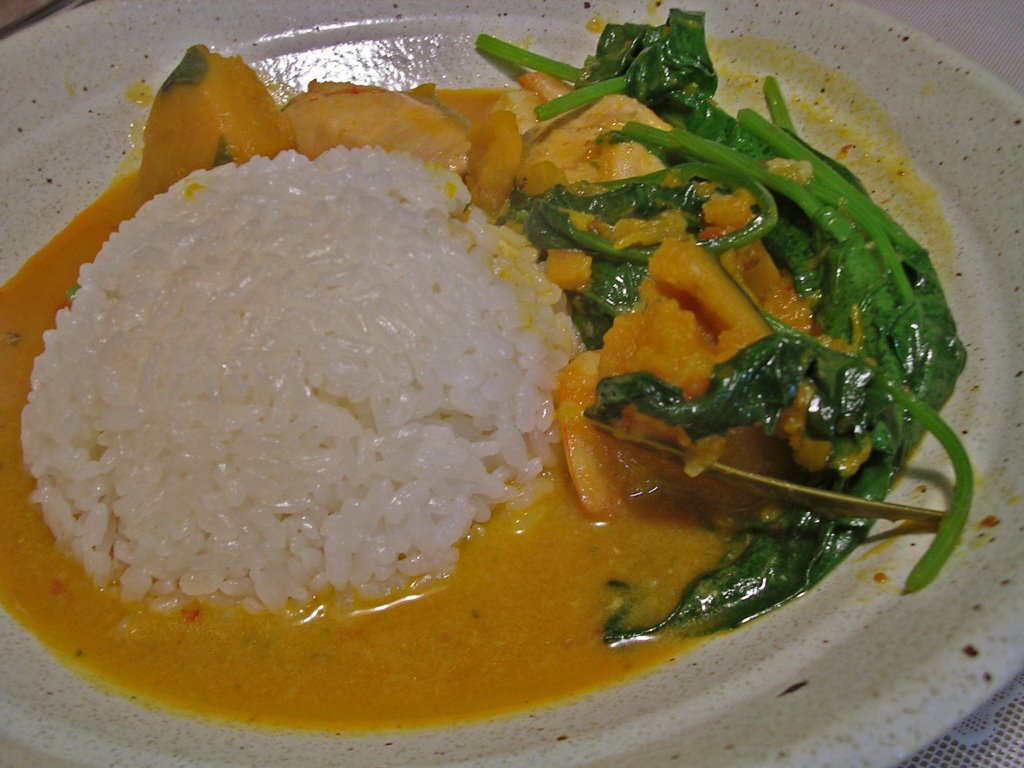
Thai red pumpkin and seafood curry **

This recipe is adapted from the book Nigella Bites or from the TV program of the same name. The list of ingredients is quite long, but it is a fairly simple recipe with guaranteed rich flavour and taste.


For 3-4 persons

- about 600-700gr pumpkin, peeled and cut into bite-sized chunks
- 4 salmon fillets, cut into bite-sized chunks
- big shrimps (as many as you want)
- a handful of spinach (or any other green vegetable)
- 1 can of coconut cream (or coconut milk if you want a lighter meal)
- 2-4 teaspoons red curry paste
- 2 teaspoons turmeric (or saffron)
- 1 garlic clove (mashed)
- a pinch of salt
- 1 teaspoon soy sauce
- 4 teaspoons fish sauce (or Nuoc Mam)
- 250ml fish stock
- 1 teaspoon sugar
- 1/2 lime
- 1 lemongrass stalk ( or dry, optional)
- coriander (fresh or dry, optional)

Put the coconut cream over medium heat into a large saucepan with the curry paste. Let it sizzle and, using a whisk, beat it together until combined. Add fish stock, fish sauce, soy sauce, turmeric, sugar, mashed garlic, lemongrass, pinch of salt, zest of half the lime, and let it sizzle for 5 minutes to bring all the flavours together.

Add the pumpkins. When they are tender (this may take between 10 and 20 minutes) add the fish and the shrimps and give them another 5 minutes. Squeeze in the juice of half the lime, and stir in the green vegetables and coriander. Mix everything and cook it for a couple more minutes.
Serve with plain Thai or basmati rice (Japonica works well too).